Manufacturing is at an inflection point. The forces reshaping the industry—supply chain realignment, persistent labor shortages, and the rapid maturation of industrial automation—are not temporary disruptions. They are structural shifts that are changing how precision components are sourced, produced, and delivered. For OEMs and engineering firms, the implications are clear: the manufacturing partners who thrive will be those who have invested in scalable production systems and the industrial technologies that make scale reliable.
The Market Signals Are Unmistakable
The precision turned product manufacturing market grew from approximately USD 121.05 billion in 2025 to USD 128.39 billion in 2026 and is forecast to reach USD 172.31 billion by 2031. Within this expansion, the machining sector specifically has demonstrated notable resilience. CNC contract manufacturing indices show significant year-on-year growth, with machining activity recording strong gains despite quarterly fluctuations driven by geopolitical headwinds. The total outsourcing value processed through UK subcontract networks alone has reached tens of millions of pounds per quarter, processing over a million parts in a single period.
What is driving this demand? The answers are consistent across industries. Aerospace manufacturers are ramping up production as commercial build rates recover. Electric vehicle programs require entirely new classes of precision components—battery housings, motor frames, and thermal management systems. Medical device manufacturers continue to miniaturize implants and surgical instruments, pushing tolerances to levels that demand the most advanced machining technology. Each of these sectors requires components produced at volumes that were unthinkable for precision machining a generation ago, with consistency that leaves no room for variation.
High-Volume CNC Machining: Beyond Speed
The term “high-volume CNC machining” is sometimes misunderstood. It is not simply about running machines faster. True high-volume production capability rests on a foundation of process stability, automation, and quality systems that maintain consistency across hundreds of thousands of parts.
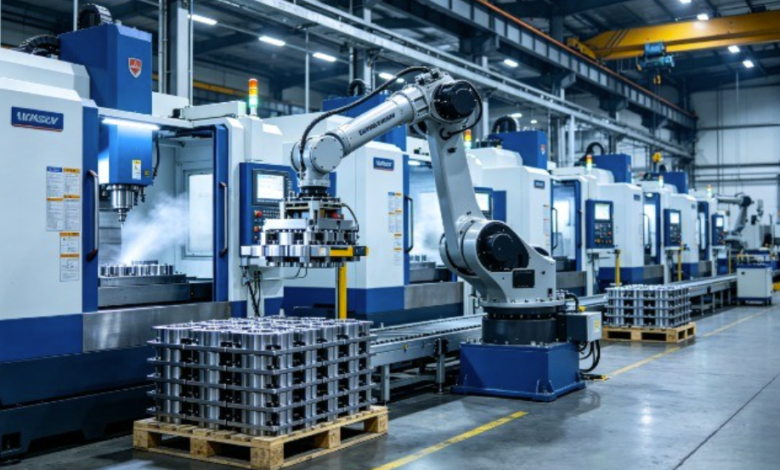
At the core is equipment utilization. A shop producing ten thousand parts per month cannot afford spindle downtime. Automated pallet changers, robotic part handling, and lights-out manufacturing systems enable continuous production with minimal operator intervention. Automated bar feeders keep raw material flowing. In-process probing verifies dimensions between cycles, allowing machines to compensate for tool wear before parts drift out of specification.
The data confirms the value of these investments. Shops that have implemented automated pallet changing systems report spindle uptime increases approaching fifty percent, with changeover labor reduced and flexibility maintained for both high-volume and prototype work. Multi-spindle systems can machine multiple components simultaneously, delivering throughput that single-spindle operations cannot match.
But equipment alone is not enough. High-volume production demands documented processes—tooling strategies validated for specific materials, cutting parameters proven across production runs, inspection protocols that catch variation before it becomes scrap. The shops that deliver consistently are those that have built institutional knowledge over thousands of production hours and documented it so that every shift, every machine, every operator produces the same result.
The Strategic Shift Toward Turnkey Manufacturing Partnerships
As production volumes climb and component complexity increases, the traditional model of managing multiple vendors—a machinist here, a finisher there, an inspector somewhere else—becomes increasingly untenable. Every handoff point introduces risk. Dimensional variance accumulates. Documentation gaps emerge. Lead times slip because one supplier in the chain fails to communicate a problem upstream.
This is why turnkey manufacturing is gaining ground. In a turnkey arrangement, a single partner takes end-to-end responsibility: material sourcing, machining, finishing, inspection, and logistics. The OEM defines the specification and the delivery date; the partner owns everything in between. Coordination gaps are eliminated. Quality continuity is preserved because the same engineering oversight governs every stage.
The implications for supply chain resilience are significant. When a component must meet aerospace or medical specifications, traceability from mill certificate to finished part is not optional. Turnkey partners maintain that traceability within a unified framework, reducing the audit burden on the OEM and providing a single point of accountability when questions arise. For manufacturers bringing production closer to end markets—whether through reshoring or regional diversification—this model offers a practical path to reliable domestic supply without rebuilding every capability in-house.
Automation and the Industrial Technology Frontier
The technologies enabling high-volume, turnkey manufacturing are evolving rapidly. Industrial AI has moved from experimental pilots to core production capability. At the 2026 Hannover Messe, the world’s leading industrial technology showcase, AI was embedded directly into production systems—physical AI driving robots on factory floors, AI agents managing production workflows autonomously, and engineering knowledge systems capturing decades of institutional experience so it can be deployed across organizations even as experienced personnel retire.
For precision machining, the practical applications are becoming clearer. AI-driven adaptive control adjusts feeds, speeds, and toolpaths in real time based on sensor feedback, maintaining quality even when material properties vary. Digital twins simulate machining operations before production begins, identifying potential problems without consuming raw material. Predictive maintenance systems monitor vibration, temperature, and power consumption to forecast tool failures before they cause unplanned downtime.
Automation is also becoming more accessible. Collaborative robots and flexible automation cells are no longer the exclusive domain of large manufacturers. Smaller shops are adopting machine tending systems and automated pallet changers that deliver immediate productivity gains without requiring a complete facility overhaul. The result is that high-volume precision manufacturing is becoming more distributed, with capable capacity available from a broader range of suppliers.
What This Means for OEMs and Engineering Leaders
For companies sourcing precision components, the current environment rewards a more rigorous approach to partner selection. The lowest quoted price is rarely the lowest total cost when component quality or delivery reliability suffers. Instead, buyers should evaluate potential partners on three fronts.
Equipment and process capability come first. Multi-axis CNC turning and milling centers with live tooling, automated bar feeders, and in-process probing are now the baseline for serious high-volume work. The ability to run unattended—lights-out—is a strong indicator that a shop has invested in the systems and documentation required for consistent production.
Workforce depth and training investment come second. The best machines are only as good as the people who program, operate, and maintain them. Shops with stable teams, documented training programs, and low turnover are better positioned to maintain quality across shifts and production runs.
Quality infrastructure comes third. Material traceability, statistical process control, and inspection protocols that satisfy regulated industries are not optional for high-volume work. They are the foundation of trust. A supplier who can provide first-article inspection reports, material certifications, and documented process controls demonstrates the discipline that high-volume manufacturing demands.
Looking Ahead
The industrial technology revolution is not waiting. The convergence of AI, automation, and connected manufacturing systems is reshaping what is possible in precision production. Components that once required weeks of lead time can now be produced in days. Tolerances that were once the domain of specialized laboratories are becoming routine. Production volumes that once demanded dedicated factories are now achievable through flexible, automated machining cells.
For manufacturers, the choice is not whether to embrace these changes but how quickly. The shops that have invested in scalable production systems, documented processes, and the automation technologies that make high-volume manufacturing reliable will capture the most demanding programs. The OEMs that partner with them will gain supply chain resilience, quality consistency, and the competitive advantage that comes from working with manufacturers who understand that in precision production, scale and quality are not opposing forces. They are complementary objectives, and achieving both is the defining challenge of modern industrial manufacturing.