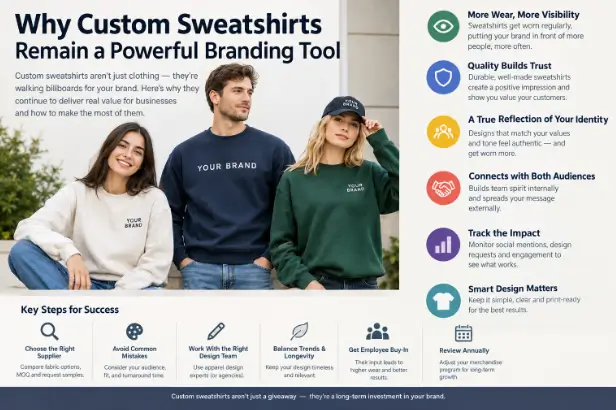
Branded merchandise comes and goes in popularity, but custom sweatshirts have stayed a reliable choice for businesses looking to put their name on something people actually want to wear. This guide looks at why sweatshirts specifically continue to work so well as a branding tool, and what to consider when ordering custom pieces for a business.
Why Sweatshirts Outperform Other Branded Items
Custom sweatshirts get worn far more often than many other branded items, like pens, tote bags, or stickers, simply because a well-made sweatshirt earns a regular spot in someone’s actual wardrobe rather than sitting in a drawer.
This higher wear frequency translates directly into more brand visibility per item distributed, which makes sweatshirts a considerably more efficient branding investment compared to items that get used once and quickly forgotten in a drawer.
Fabric Quality and Long-Term Brand Perception
A cheap, thin sweatshirt that falls apart after a few washes reflects poorly on the brand printed across it, regardless of how good the logo design looks on day one. Fabric quality directly shapes how customers perceive the business behind the merchandise.
Brands known for durable construction, including Carhartt Sweatshirt lines, offer a useful reference point for the fabric weight and stitching quality that separates a sweatshirt worth keeping from one that gets discarded within a season.
Branded Apparel as an Extension of Company Identity
Branded apparel works best when it reflects something genuine about a company’s identity, rather than existing purely as a logo delivery vehicle. A sweatshirt design that matches a company’s actual tone and values tends to get worn more often than a generic, purely promotional design.
Involving actual employees or customers in design feedback before finalizing a custom sweatshirt order often produces a piece people genuinely want to wear, rather than one that ends up unused and forgotten after an initial distribution.
Company Merchandise for Internal and External Audiences
Company merchandise serves two different purposes depending on the audience. Internal merchandise for employees builds team identity and morale, while external merchandise for customers or event attendees functions more directly as brand marketing.
Designing slightly different versions for each audience, rather than using one identical design for both, often produces better results than trying to serve two different purposes with a single generic sweatshirt.
Promotional Products and Measuring Actual Impact
Promotional products like custom sweatshirts are harder to measure directly than digital marketing, but tracking simple signals, like requests for a specific design or mentions on social media, gives a rough sense of how well a piece is performing as a branding tool.
Businesses that treat merchandise as a one-time expense rather than an ongoing brand investment often miss opportunities to refine future designs based on what actually resonated with recipients.
Custom Clothing Design Considerations for Branding
Custom clothing designed specifically for branding purposes benefits from a simple, recognizable logo placement rather than an overly busy design that competes with itself for attention on a small chest or sleeve area.
Testing a design at actual print size, rather than judging it only on a screen, helps confirm that small details remain legible and that the overall composition looks balanced once printed on fabric.
Sourcing Custom Sweatshirts for a Brand Campaign
Checking a detailed Custom Sweatshirts buying guide before selecting a supplier helps businesses compare fabric options and minimum order requirements side by side, rather than choosing based on price alone.
Requesting a physical sample before committing to a full order remains the most reliable way to confirm both fabric quality and print execution genuinely match expectations before a larger campaign launches across the full order.
Common Mistakes When Ordering Branded Sweatshirts
Many businesses order branded sweatshirts based on internal preferences alone, without considering whether the design and fit will actually suit the intended recipients. A design the marketing team loves does not always translate to a piece people want to wear regularly.
Others underestimate turnaround time for custom printing, especially around busy seasons, which can delay a campaign launch significantly if ordering happens too close to an already planned release date on the marketing calendar.
Working With Design Agencies Versus In-House Teams
Smaller businesses without a dedicated design team often benefit from working with an outside agency or freelance designer experienced specifically in apparel graphics, since designing for fabric and print methods differs meaningfully from designing for digital or print media.
Reviewing a designer’s past apparel-specific work, rather than only their general portfolio, helps confirm they understand the practical constraints of printing or embroidering on fabric before committing to a full design contract.
Balancing Design Trends With Brand Longevity
Chasing every current design trend for branded sweatshirts can make a piece feel dated within a year or two, while a more lasting approach to logo placement and color choice tends to stay relevant across a longer stretch of a company’s branding history.
Businesses that revisit their core merchandise design only occasionally, rather than constantly refreshing it, often build stronger recognition over time than those switching designs with every new order.
Getting Employee Buy-In on Branded Apparel
Employees are more likely to actually wear branded apparel outside of work if they had some input into the design process, rather than receiving a piece decided entirely by leadership without any consultation.
A short survey or informal feedback round before finalizing a company sweatshirt design often surfaces preferences around fit, color, and placement that leadership alone might overlook.
Revisiting Merchandise Programs Annually
Setting aside time once a year to review an entire merchandise program, rather than only evaluating individual orders, helps a business spot broader trends worth adjusting across future branding decisions.
Building a Lasting Branding Strategy Around Custom Sweatshirts
Custom sweatshirts remain a powerful branding tool because they combine high visibility, extended wear time, and a tangible connection to a brand that digital marketing alone cannot replicate.
Businesses that invest in fabric quality, thoughtful design, and reliable suppliers get far more branding value out of each piece distributed than those treating merchandise as a rushed afterthought squeezed into an existing budget.